Me 10 years ago: I never use online abbreviations! standard english all the time!
Me a couple of years ago: u kno wat fuck it
Me now: it is impossible to communicate effectively online without using internet slang due to the mixed mode format and lack of paralinguistic features. Things like lack of punctuation, abbreviations, acronyms and such all have their own connotations and communicate far more than their commonly accepted meaning. Linguistics has evolved. n u kno what i love it
Tag: language
“Cemetery” and “Graveyard” in European languages.
When I was beginning to discover languages, I had a romanticized view of words like “speak” and “fluency”. But then I realized that you can be nominally fluent in a language and still struggle to understand parts of it. English is my first language, but what I really spoke was a hybrid of teenage slang and Manhattan-ese. When I listen to my father, a lawyer, talk to other lawyers, his words sound as foreign to me as Finnish. I certainly couldn’t read Shakespeare without a dictionary, and I’d be equally helpless in a room with Jamaicans or Cajuns. Yet all of us “speak English.”
My linguistics teacher, a native of Poland, speaks better English than I do and seems right at home peppering his speech with terms like “epenthetic schwa” and “voiceless alveolar stops”. Yet the other day, it came up that he’d never heard the word “tethered”. Does that mean he doesn’t “speak” English? If the standard of speaking a language is to know every word — to feel equally at home debating nuclear fission and classical music — then hardly anyone is fluent in their own native tongues.
Tim Doner (x)
The average native English speaker learns about 1 new English word per day between the ages of 16 and 50.
(via allthingslinguistic)
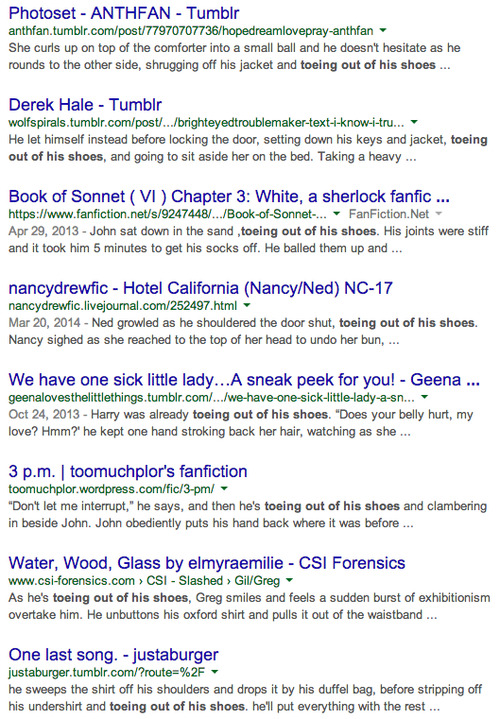
so i just googled the phrase “toeing out of his shoes” to make sure it was an actual thing
it’s all fanfiction
which reminds me that i’ve only ever seen the phrase “carding fingers through his hair” and people describing things like “he’s tall, all lean muscle and long fingers,” like that formula of “they’re ____, all ___ and ____” or whatever in fic
idk i just find it interesting that there are certain phrases that just sort of evolve in fandom and become prevalent in fic bc everyone reads each other’s works and then writes their own and certain phrases stick
i wish i knew more about linguistics so i could actually talk about it in an intelligent manner, but yeah i thought that was kinda cool
Ha! Love it!
One of my fave authors from ages ago used the phrase “a little helplessly” (like “he reached his arms out, a little helplessly”) in EVERY fic she wrote. She never pointed it out—there just came a point where I noticed it like an Easter egg. So I literally *just* wrote it into my in-progress fic this weekend as an homage only I would notice. ❤
To me it’s still the quintessential “two dudes doing each other” phrase.
I think different fic communities develop different phrases too! You can (usually) date a mid 00s lj fic (or someone who came of age in that style) by the way questions are posed and answered in the narration, e.g. “And Patrick? Is not okay with this.” and by the way sex scenes are peppered with “and, yeah.” I remember one Frerard fic that did this so much that it became grating, but overall I loved the lj style because it sounded so much like how real people talk.
Another classic phrase: wondering how far down the _ goes. I’ve seen it mostly with freckles, but also with scars, tattoos, and on one memorable occasion, body glitter at a club. Often paired with the realization during sexy times that “yeah, the __ went all they way down.” I’ve seen this SO much in fic and never anywhere else
whoa, i remember reading lj fics with all of those phrases! i also remember a similar thing in teen wolf fics in particular – they often say “and derek was covered in dirt, which. fantastic.” like using “which” as a sentence-ender or at least like sprinkling it throughout the story in ways published books just don’t.
LINGUISTICS!!!! COMMUNITIES CREATING PHRASES AND SLANG AND SHAPING LANGUAGE IN NEW WAYS!!!!!!!
I love this. Though I don’t think of myself as fantastic writer, by any means, I know the way I write was shaped more by fanfiction and than actual novels.
I think so much of it has to do with how fanfiction is written in a way that feels real. conversations carry in a way that doesn’t feel forced and is like actual interactions. Thoughts stop in the middle of sentences.
The coherency isn’t lost, it just marries itself to the reader in a different way. A way that shapes that reader/writer and I find that so beautiful.
FASCINATING
and it poses an intellectual question of whether the value we assign to fanfic conversational prose would translate at all to someone who reads predominantly contemporary literature. as writers who grew up on the internet find their way into publishing houses, what does this mean for the future of contemporary literature? how much bleed over will there be?
we’ve already seen this phenomenon begin with hot garbage like 50 shades, and the mainstream public took to its shitty overuse of conversational prose like it was a refreshing drink of water. what will this mean for more wide-reaching fiction?
QUESTIONS!
I’m sure someone could start researching this even now, with writers like Rainbow Rowell and Naomi Novik who have roots in fandom. (If anyone does this project please tell me!) It would be interesting to compare, say, a corpus of a writer’s fanfic with their published fiction (and maybe with a body of their nonfiction, such as their tweets or emails), using the types of author-identification techniques that were used to determine that J.K. Rowling was Robert Galbraith.
One thing that we do know is that written English has gotten less formal over the past few centuries, and in particular that the word “the” has gotten much less frequent over time.
In an earlier discussion, Is French fanfic more like written or spoken French?, people mentioned that French fanfic is a bit more literary than one might expect (it generally uses the written-only tense called the passé simple, rather than the spoken-only tense called the passé composé). So it’s not clear to what extent the same would hold for English fic as well – is it just a couple phrases, like “toeing out of his shoes”? Are the google results influenced by the fact that most published books aren’t available in full text online? Or is there broader stuff going on? Sounds like a good thesis project for someone!
See also: the gay fanfiction pronoun problem, ship names, and the rest of my fanguistics tag.
French Person: I’ve got four twenties, ten and nine problems and the way my language counts is one of them
for chinese new year they get all these famous actors and comedians together and they do a lil show and one of the comedians was like “i was in a hotel in america once and there was a mouse in my room so i called reception except i forgot the english word for mouse so instead i said ‘you know tom and jerry? jerry is here’
jerry is here
my chinese teacher once shared this story in class about someone who went to the grocery to buy chicken, but they forgot the english word for it, so they grabbed an egg, went to the nearest sales lady and said “where’s the mother”
When I was a teenager, we went to Italy for the summer holidays. We are German, neither of us speaks more than a few words of Italian. That didn’t keep my family from always referring to me when they wanted something translated because “You’re so good with languages and you took Latin”. (I told them a hundred times I couldn’t order ice cream in Latin, they ignored that.) Anyway, my dad really loved a certain cheese there, made from sheep’s milk. He knew the Italian word for ‘cheese’ – formaggio – and he knew how to say ‘please’. And he had already spotted a little shop that sold the cheese. He asked me what ‘sheep’ was in Italian, and of course, I had no idea. So he just shrugged and said “I’ll manage” and went into the shop. 5 mins later, he comes out with a little bag, obviously very pleased with himself.
How did he manage it? He had gone in and said “’Baaaah’ formaggio, prego.”I was done for the day.
This makes me feel better about every conversation I had in both Rome and Ghent.
I once lost my husband in the ruins of a French castle on a mountain, and trotted around looking for him in increasing desperation. “Have you seen my husband?” I asked some French people, having forgotten all descriptive words. “He is small, and English. His hair is the color of bread.”
I did not find my husband in this way.
In rural France it is apparently Known that one brings one’s own shopping bags to the grocery store. I was a visitor and had not been briefed and had no shopping bag. I saw that other people were able to conduct negotiations to purchase shopping bags, but I could not remember the word for “bag.”
“Can I have a box that is not a box,” I said.
The checkout lady looked extremely tired and said, “Un sac?” (A sack?)
Of course. A fucking sack. And so I did get a sack.
In paris in the early 2000s i was trying to find a cell phone rental booth in the airport and i was exhausted. “Excuse me,” I remember asking a security guard. “Where does he find himself, the house where one can buy for a short time the little phone?”
“Buy for a short time?” repeated the guard. “The house?”
“The hat,” I said desperately. “The castle. No – the newsstand. If it pleases you, I want to buy him and then return him: the little phone.”
Germany in European languages
No matter how kind you are, German children are kinder.
A video from @thelingspace on third language acquisition. There’s not as much research on third language acquisition as there is second language, partly because it’s much harder to find people who speak the same three languages, in the same order, at the same level of fluency, but I’ve written about my own experience maintaining multiple languages without mixing them up.
(Source: https://www.youtube.com/)
“Where is a frown?” Americans say mouth, Brits say forehead (my mind=blown)
This recent post from Lynne Murphy on Separated By a Common Language created much discussion in my Twitter feed and over dinner with a collection of American, British and Australian English speakers. Many of us have been living with semantic variation staring up in the face. Even (American English) Lynne didn’t realise her (British English) husband had a difference sense from her:
When I tweeted the question “Where is a frown?” British people told me
“on the forehead”. When I asked the Englishman in my house, he said the
same thing. Fourteen years together and only now do I know that he’s
been frowning much of the time.And like one of the blog commenters, the Brits I talked with had an epiphany: so that’s why Americans say “turn your frown upside down!” to mean ‘cheer up!’.
Older Australian English speakers I talked to identified the forehead frown as the sense that they have, but a frown has always been the opposite of a smile for me, all about the mouth. Otherwise, what is the opposite of a smile? It looks like we have some intergenerational semantic shift happening right under our noses.
See Lynne’s original post on Separated by a Common Language.
I’m Canadian and I also have the mouth meaning for frown (as it seems do Canadians in general per Michael Wagner’s post), so I’ve come to an epiphany of my own: this must be the origin of the expression “it takes [large number] of muscles to frown, but only [small number] of muscles to smile.” Curving your lips down doesn’t feel like it takes that many muscles, but furrowing your brow definitely does.
 326 Miles