even if joan of arc could’ve used bobby pins she wouldn’t have. someone would have offered her one bc her hair was in her eyes and she would’ve been like oh no thank you and then calmly and methodically hacked off the offending hair chunk with a sword
Latin has this word, sic. Or, if we want to be more diacritically accurate, sīc. That shows that the i is long, so it’s pronounced like “seek” and not like “sick.”
You might recognize this word from Latin sayings like “sic semper tyrannis” or “sic transit gloria mundi.” You might recognize it as what you put in parentheses when you want to be pass-agg about someone’s mistakes when you’re quoting them: “Then he texted me, ‘I want to touch you’re (sic) butt.’”
It means, “thus,” which sounds pretty hoity-toity in this modren era, so maybe think of it as meaning “in this way,” or “just like that.” As in, “just like that, to all tyrants, forever,” an allegedly cool thing to say after shooting a President and leaping off a balcony and shattering your leg. “Everyone should do it this way.”
Anyway, Classical Latin somewhat lacked an affirmative particle, though you might see the word ita, a synonym of sic, used in that way. By Medieval Times, however, sic was holding down this role. Which is to say, it came to mean yes.
Ego: Num edisti totam pitam?
Tu, pudendus: Sic.
Me: Did you eat all the pizza?
You, shameful: That’s the way it is./Yes.
This was pretty well established by the time Latin evolved into its various bastard children, the Romance languages, and you can see this by the words for yes in these languages.
In Spanish, Italian, Asturian, Catalan, Corsican, Galician, Friulian, and others, you say si for yes. In Portugese, you say sim. In French, you say si to mean yes when you’re contradicting a negative assertion (”You don’t like donkey sausage like all of us, the inhabitants of France, eat all the time?” “Yes, I do!”). In Romanian, you say da, but that’s because they’re on some Slavic shit. P.S. there are possibly more Romance languages than you’re aware of.
But:
There was still influence in some areas by the conquered Gaulish tribes on the language of their conquerors. We don’t really have anything of Gaulish language left, but we can reverse engineer some things from their descendants. You see, the Celts that we think of now as the people of the British Isles were Gaulish, originally (in the sense that anyone’s originally from anywhere, I guess) from central and western Europe. So we can look at, for example, Old Irish, where they said tó to mean yes, or Welsh, where they say do to mean yes or indeed, and we can see that they derive from the Proto-Indo-European (the big mother language at whose teat very many languages both modern and ancient did suckle) word *tod, meaning “this” or “that.” (The asterisk indicates that this is a reconstructed word and we don’t know exactly what it would have been but we have a pretty damn good idea.)
So if you were fucking Ambiorix or whoever and Quintus Titurius Sabinus was like, “Yo, did you eat all the pizza?” you would do that Drake smile and point thing under your big beefy Gaulish mustache and say, “This.” Then you would have him surrounded and killed.
Apparently Latin(ish) speakers in the area thought this was a very dope way of expressing themselves. “Why should I say ‘in that way’ like those idiots in Italy and Spain when I could say ‘this’ like all these cool mustache boys in Gaul?” So they started copying the expression, but in their own language. (That’s called a calque, by the way. When you borrow an expression from another language but translate it into your own. If you care about that kind of shit.)
The Latin word for “this” is “hoc,” so a bunch of people started saying “hoc” to mean yes. In the southern parts of what was once Gaul, “hoc” makes the relatively minor adjustment to òc, while in the more northerly areas they think, “Hmm, just saying ‘this’ isn’t cool enough. What if we said ‘this that’ to mean ‘yes.’” (This is not exactly what happened but it is basically what happened, please just fucking roll with it, this shit is long enough already.)
So they combined hoc with ille, which means “that” (but also comes to just mean “he”: compare Spanish el, Italian il, French le, and so on) to make o-il, which becomes oïl. This difference between the north and south (i.e. saying oc or oil) comes to be so emblematic of the differences between the two languages/dialects that the languages from the north are called langues d’oil and the ones from the south are called langues d’oc. In fact, the latter language is now officially called “Occitan,” which is a made-up word (to a slightly greater degree than that to which all words are made-up words) that basically means “Oc-ish.” They speak Occitan in southern France and Catalonia and Monaco and some other places.
The oil languages include a pretty beefy number of languages and dialects with some pretty amazing names like Walloon, and also one with a much more basic name: French. Perhaps you’ve heard of it, n’est-ce pas?
Yeah, eventually Francophones drop the -l from oil and start saying it as oui. If you’ve ever wondered why French yes is different from other Romance yeses, well, now you know.
I guess what I’m getting at is that when you reblog a post you like and tag it with “this,” or affirm a thing a friend said by nodding and saying “Yeah, that”: you’re not new
this is all amazing, but I’m now waiting for people to start reblogging posts with the additional comment “SIC”.
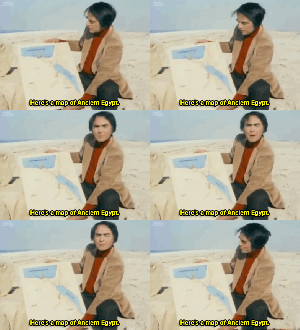
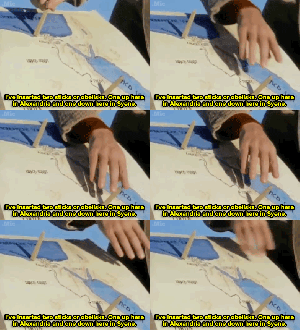
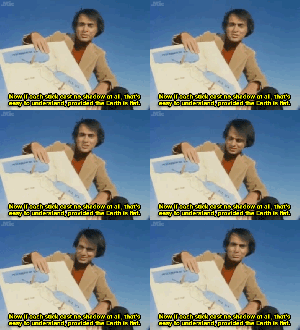
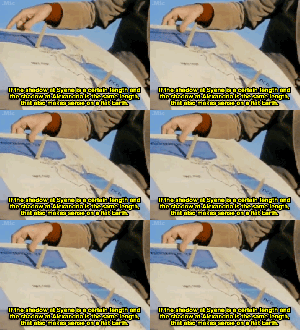
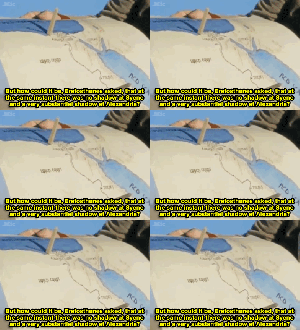
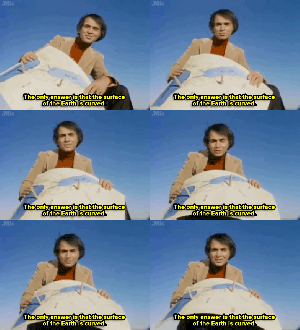
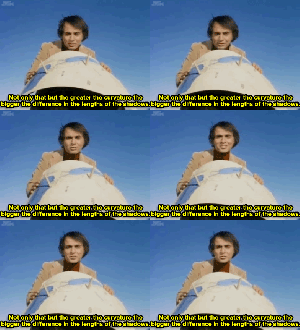
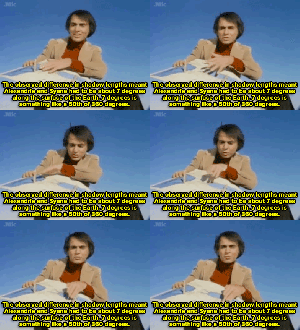
bipch erastosthenes schooled b.o.b. 2,230 years ago
Ok so this is cool but I always wondered how they knew the shadows were different at the same instant. I mean it is not like they had phones. How did they sync up that instant. I feel like that would be interesting to know but no one ever says.
^^^Does anybody know this one? How, that far apart, the time at which the shadows were observed was synced up? I am genuinely curious, not a goddamn moron asking a gotcha question. High/Low tide? (I live in the middle of the country I do not know for the precise habits of tidal activity.) The appearance of a star (or planet) in the sky? Something as utterly mundane as sunrise?
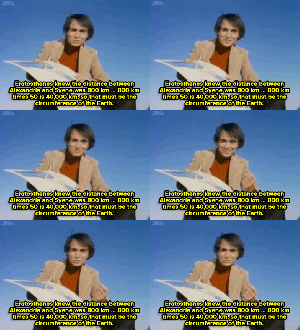
Well, first of all, it wasn’t actually pillars! Eratosthenes was told about a well in Syene that, in the summer solstice every year (June 21st) would be illuminated at the bottom entirely and without any cast shadows. This indicated that the sun was directly overhead. Going off that well known curiosity and an intelligent hunch, our dude Eratosthenes waited until high noon of the summer solstice to measure the angle of a shadow cast by a stick in Alexandria. (Sidenote: Eratosthenes was a librarian of the infamous Library of Alexandria.)
His next course of action was to hire bematists, surveyors of the time whose professional specialty was to measure distance by walking with equal length steps. They measured a distance between Alexandria and Syene of about 5000 stadia. (Guess where the word stadium comes from.) Once he had that measurement, Eratosthenes did his math-y thing, and there you have it.
ANSWER EVEN COOLER THAN I HOPED!!
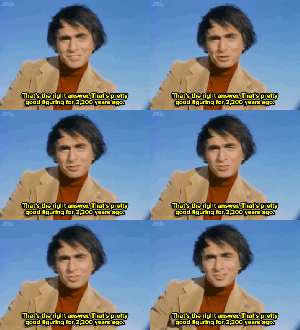
Eratosthenes’ work was thorough enough that by the time he finished revising his calculations, he ended up only 66 km off of the actual polar circumference of the Earth, or an error margin of 0.16%. [wiki]
I met a baby the other day who taught me that kids aren’t learning the thumb-and-pinky-out gesture for “phone” anymore. She puts her flat, open palm up to her ear and babbles into it, simulating a flat and rectangular smartphone.
It’s so interesting that a lot of seemingly obsolete hand motions still exist, though
very few people wear wristwatches, but tapping one’s wrist is still a nearly universal gesture for “what time is it?” or “hurry up”
I used classic corded phones for only a very brief time in my life (before we got those more rectangular-shaped cordless ones for my parents’ landline) and first saw a car without power windows when I was in college, and yet I’ve always used the pinky-and-thumb gesture for “call me” and the circling-fist gesture for “roll down your window.” I’m 24, so my childhood was the late 90s and early 2000s, but I still use gestures that indicate technology either gone or on its way out when I began forming reliable memories
it also makes me wonder how people indicated time or hurrying before wristwatches. did they somehow pantomime a pocket watch? what gestures have we lost as technology marches on? and since video didn’t exist for most of human history, how might we learn what they were? like the contents of the third Georgian spice jar or the location of Punt, nobody would think to write any of it down
I just love history so much
The ASL sign for phone is based on the pinky-and-thumb gesture. Presumably that will continue on for a while, with future generations seeing it as an arbitrary sign.
And then there are words like “rewind” that no longer make literal sense. Filmmakers still use “cut” long after actual physical film that can be cut fell out of use. We talk about cutting and pasting on computers and use a floppy disc icon for “save”.
Fossilized metaphors are the best.
So the cool thing about
skeuomorphisms (like the floppy disc icon) is that it’s entire basis is that, originally, the skeuomorph’s form had a resemblance to the literal processes it was referencing but that now they’re not referencing literal processes, but the abstract idea of those processes.
We’re not literally rewinding a tape when we hit rewind on our DVRs or DVD’s. Instead, we understand that to “rewind” is to reverse the playback of the video/audio, often at several times its normal speed. The word has changed from meaning the literal process which resulted in the desired effect to directly meaning the desired effect. This is something that just happens in language over time. I mean, shit, the British call flashlights “Torches” and that makes perfect sense.
Thing is, the only reason it seems weird to us is because we’ve seen and used the original things that the skeuomorphs and gestures are referencing. It’s not just a representation of an abstract idea like saving a file or cutting footage or making a call. We’ve used floppy discs and razors and corded telephone handsets. They were real, commonplace things in our lives and jobs.
It’s weird to us because we’re living in the transition period. It’ll stop being weird once we die and no one is around to remember the original thing.
i just love old things so much. i love standing in a ruin knowing that it was once a city or a building real people lived and walked in, or seeing a weapon someone used to wield to fight for a nation that no longer exists, or a statue of someone who’s been dead for thousands of years. i love hearing songs that have been sung for centuries, or eating foods with ancient recipes. i love the idea that even when people have passed and civilisations have fallen there are still little pieces of the past we can feel today.
i feel like a good rule of thumb for historians/historical biographers is that the reader shouldn’t be able to tell which historical figures you want to have sex with


 326 Miles
