Here’s the orbital period of our solar system’s 8 major planets (how long it takes each to travel around the sun). Their size is to scale and their speed is accurate relative to Earth’s. The repetition of each GIF is proportional to their orbital period. Mercury takes less than 3 months to zoom around Sol, Neptune takes nearly 165 years.
fuck this gifset do you know how long i sat here waiting for fucking neptune to drag its lazy ass into the frame
i thought i’d written this up on here before, but i can’t find it. so let me tell you my favourite story about my time in oxford.
my college library is a converted church (with graveyard still attached). and it closed at about 1am every night, but they let people keep working in the vestry – where there were… i think six desks? – overnight. i was not very good at doing my work at anything other than the absolute last minute, and would fairly often end up in the vestry the night before an essay was due.
it was grim. honestly i do not miss it.
the highlight of those nights was when i allowed myself a break to go out to buy a burger from the kebab van that was on the other side of the high street. the nearest kebab van was ahmed’s. kebab vans in oxford are serious business (there are few kebab shops, and they’re mostly not near the colleges, where the first and third-year students often live in). i just looked ahmed’s up to check i was spelling his name right and found this amazing painting of the van!!
anyway. so one night in – i guess it was probably april? i think it was in my final year, and not too long to go before exams – i walked out to the kebab van. it was 2am, or maybe 3am. a weeknight – maybe a tuesday – and there was nobody around. too late for other people taking study breaks, and maybe the people who were out clubbing weren’t coming back yet. i felt like i and ahmed and the other guy who worked in his van were the only people alive.
and then an entire band of men turned up in full 16th century regalia.
i think maybe one or two of them had musical instruments with them, but not all of them. they stood there. they didn’t seem to think that they were doing anything unusual. i guess for them, it wasn’t. nobody else came by. nobody said anything except to order some food.
i thought: am i hallucinating??? what is happening???
i always ordered a cheeseburger at ahmed’s, and as it wasn’t a busy night they didn’t already have any cooking, so i stood by the van for a good five minutes while it cooked, just watching these men, who seemed like time-travellers, solemnly order their kebabs. none of them had phones out or anything. nothing broke the illusion except the situation we were in. it honestly felt like time was collapsing. like we had all been pulled out of the timestream and were just chilling here together. it wasn’t april whatever, 3am, 2011. it was no time, no place. The Kebab Van At The End of Time.
they just seemed like people from the past who wanted to get something to eat. an eternal constant. and the guys in the van were as nonchalant about it as the men themselves were. yeah, we get sixteenth century people through here all the time.
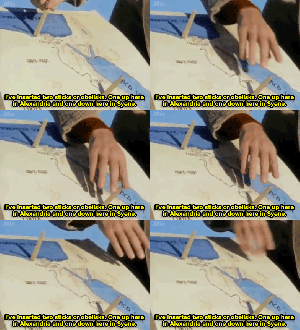
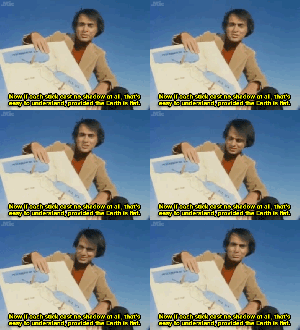
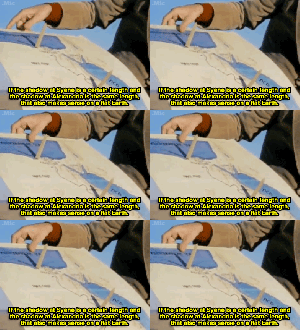
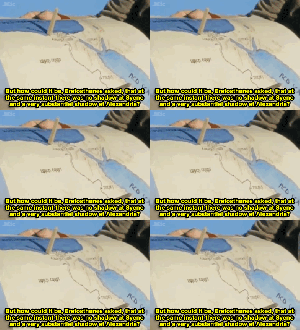
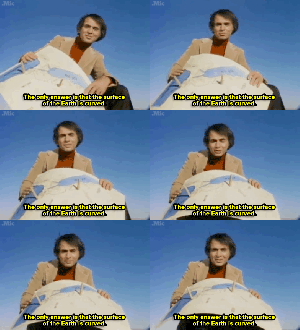
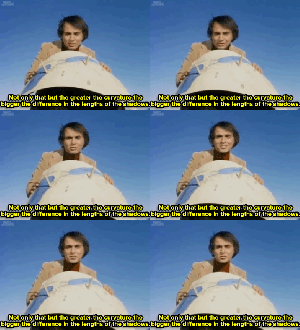
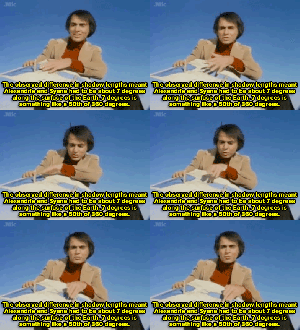
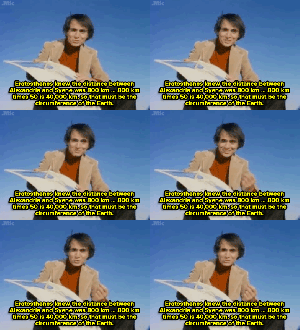
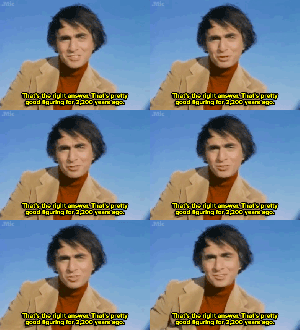
bipch erastosthenes schooled b.o.b. 2,230 years ago
Ok so this is cool but I always wondered how they knew the shadows were different at the same instant. I mean it is not like they had phones. How did they sync up that instant. I feel like that would be interesting to know but no one ever says.
^^^Does anybody know this one? How, that far apart, the time at which the shadows were observed was synced up? I am genuinely curious, not a goddamn moron asking a gotcha question. High/Low tide? (I live in the middle of the country I do not know for the precise habits of tidal activity.) The appearance of a star (or planet) in the sky? Something as utterly mundane as sunrise?
Well, first of all, it wasn’t actually pillars! Eratosthenes was told about a well in Syene that, in the summer solstice every year (June 21st) would be illuminated at the bottom entirely and without any cast shadows. This indicated that the sun was directly overhead. Going off that well known curiosity and an intelligent hunch, our dude Eratosthenes waited until high noon of the summer solstice to measure the angle of a shadow cast by a stick in Alexandria. (Sidenote: Eratosthenes was a librarian of the infamous Library of Alexandria.)
His next course of action was to hire bematists, surveyors of the time whose professional specialty was to measure distance by walking with equal length steps. They measured a distance between Alexandria and Syene of about 5000 stadia. (Guess where the word stadium comes from.) Once he had that measurement, Eratosthenes did his math-y thing, and there you have it.
ANSWER EVEN COOLER THAN I HOPED!!
Eratosthenes’ work was thorough enough that by the time he finished revising his calculations, he ended up only 66 km off of the actual polar circumference of the Earth, or an error margin of 0.16%. [wiki]
I met a baby the other day who taught me that kids aren’t learning the thumb-and-pinky-out gesture for “phone” anymore. She puts her flat, open palm up to her ear and babbles into it, simulating a flat and rectangular smartphone.
It’s so interesting that a lot of seemingly obsolete hand motions still exist, though
very few people wear wristwatches, but tapping one’s wrist is still a nearly universal gesture for “what time is it?” or “hurry up”
I used classic corded phones for only a very brief time in my life (before we got those more rectangular-shaped cordless ones for my parents’ landline) and first saw a car without power windows when I was in college, and yet I’ve always used the pinky-and-thumb gesture for “call me” and the circling-fist gesture for “roll down your window.” I’m 24, so my childhood was the late 90s and early 2000s, but I still use gestures that indicate technology either gone or on its way out when I began forming reliable memories
it also makes me wonder how people indicated time or hurrying before wristwatches. did they somehow pantomime a pocket watch? what gestures have we lost as technology marches on? and since video didn’t exist for most of human history, how might we learn what they were? like the contents of the third Georgian spice jar or the location of Punt, nobody would think to write any of it down
I just love history so much
The ASL sign for phone is based on the pinky-and-thumb gesture. Presumably that will continue on for a while, with future generations seeing it as an arbitrary sign.
And then there are words like “rewind” that no longer make literal sense. Filmmakers still use “cut” long after actual physical film that can be cut fell out of use. We talk about cutting and pasting on computers and use a floppy disc icon for “save”.
Fossilized metaphors are the best.
So the cool thing about
skeuomorphisms (like the floppy disc icon) is that it’s entire basis is that, originally, the skeuomorph’s form had a resemblance to the literal processes it was referencing but that now they’re not referencing literal processes, but the abstract idea of those processes.
We’re not literally rewinding a tape when we hit rewind on our DVRs or DVD’s. Instead, we understand that to “rewind” is to reverse the playback of the video/audio, often at several times its normal speed. The word has changed from meaning the literal process which resulted in the desired effect to directly meaning the desired effect. This is something that just happens in language over time. I mean, shit, the British call flashlights “Torches” and that makes perfect sense.
Thing is, the only reason it seems weird to us is because we’ve seen and used the original things that the skeuomorphs and gestures are referencing. It’s not just a representation of an abstract idea like saving a file or cutting footage or making a call. We’ve used floppy discs and razors and corded telephone handsets. They were real, commonplace things in our lives and jobs.
It’s weird to us because we’re living in the transition period. It’ll stop being weird once we die and no one is around to remember the original thing.




















 326 Miles